 Observia Editorial Team
The workplace safety technology market is evolving at an unprecedented pace, with organizations increasingly moving beyond traditional solutions like Protex.ai to discover platforms that genuinely align with their operational realities, budgets, and strategic priorities.
What worked five years ago, expensive hardware overhauls, months-long implementations, privacy-invasive surveillance, no longer represents the cutting edge of occupational safety.
Today’s organizations face a more nuanced decision landscape.
“ Can we leverage existing infrastructure? How do we balance security with worker privacy? What’s the true cost of ownership when you factor in integration, training, and ongoing support? How quickly can we actually deploy and start preventing incidents?
The good news is that 2026 presents an an abundance of options for organizations seeking modern workplace safety solutions.
Several compelling alternatives have matured, each bringing distinct strengths to different organizational contexts.
Whether you’re a mid-market manufacturer, a sprawling logistics operation, a construction firm managing multiple sites, or a high-consequence industry like mining or utilities, there’s likely a platform that fits your needs better than the incumbents.
This comprehensive guide explores the landscape of Protex.ai alternatives, providing deep analysis of each platform’s capabilities, trade-offs, and ideal use cases.
We’ll help you navigate the decision process with clarity and confidence.
The Top Protex.ai Alternatives in 2026
1. Observia.ai ⭐ Rising Star
What It Does
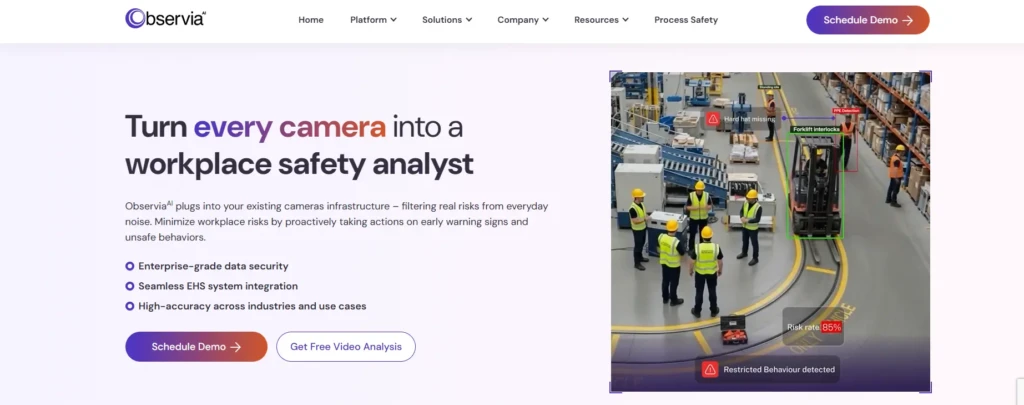
Observia.ai represents a fundamentally different approach to workplace safety, one built from first principles for modern operational environments.
It delivers real-time AI-powered hazard detection while maintaining privacy-first architecture that respects worker dignity and addresses modern regulatory concerns around data protection.
The platform integrates with your existing camera infrastructure (a massive cost advantage) to provide intelligent monitoring without requiring complete system replacement.
It processes video feeds in real-time, identifies hazards, generates contextual alerts, and, critically, does not store footage, instead relying on privacy-preserving analysis techniques like automated face blurring and edge-based processing.
Key Strengths
Seamless Integration with Existing Infrastructure This is Observia.ai’s knockout advantage. Most safety platforms demand new hardware investments, replacing CCTV systems, installing proprietary cameras, deploying edge devices across facilities.
Observia.ai works with what you have. Already running standard IP cameras? Connect them. Already invested in CCTV infrastructure? Leverage it. This eliminates one of the biggest barriers to deployment: capital expenditure and the logistical nightmare of hardware replacement.
Privacy-First Architecture Observia.ai challenges the surveillance mentality that pervades older safety platforms.
The system performs hazard detection and analysis on video feeds without storing the footage. Worker faces are automatically blurred in any retained data. This approach addresses legitimate worker concerns about privacy invasion while simultaneously helping organizations meet GDPR, CCPA, and other privacy regulations. In an era where worker trust and retention are competitive advantages, this matters significantly.
Intelligent Alert Filtering False positives are the cancer of safety monitoring systems. When your team receives dozens of alerts daily, most of them inconsequential, alert fatigue sets in. Safety personnel stop responding seriously to warnings. The entire system becomes counterproductive.
Observia.ai’s machine learning engine understands context. It distinguishes between a worker briefly stooping to pick something up and an actual fall risk. It knows the difference between someone removing PPE momentarily and genuine non-compliance. This intelligent filtering means your safety team actually investigates alerts because they know they matter.
Cloud-Based Deployment in Days, Not Months Traditional implementations involve months of planning, hardware procurement, infrastructure setup, network configuration, staff training, and system tuning. Observia.ai deploys in days. You connect your cameras, configure basic parameters, and the system is live. This rapid time-to-value is critical for organizations facing immediate safety challenges or wanting quick proof-of-concept before deeper investment.
Automated Compliance Reporting Observia.ai generates comprehensive compliance documentation automatically. Rather than safety managers manually compiling incident reports, shift logs, and regulatory submissions, the system creates audit-ready documentation. This reduces administrative burden and ensures consistency in reporting, critical for organizations facing regulatory scrutiny.
Real-Time Incident Tracking The platform provides immediate visibility into safety incidents as they occur, enabling rapid response protocols. Multi-user dashboards allow safety managers, shift supervisors, and executives to view incidents and hazard trends simultaneously.
Customizable Alert Thresholds Different facilities have different risk tolerances and operational requirements. Observia.ai allows configuration of alert sensitivity on a per-location, per-hazard basis, ensuring the system reflects your specific operational context rather than forcing you into a one-size-fits-all configuration.
Best For
Where Observia.ai tends to win
Observia.ai excels for mid-market organizations and companies with existing CCTV infrastructure across multiple facilities. It’s particularly well-suited for:
- Manufacturing (automotive, food processing, pharmaceuticals, electronics)
- Logistics & distribution centers
- Construction companies (project-based and ongoing operations)
- Utilities & energy sector
- Food & beverage production
- Warehousing and fulfillment operations
The platform works best for organizations that want modern safety technology without massive infrastructure investment—especially where time-to-deployment matters and worker privacy concerns are significant.
Why It Stands Out
Observia.ai fundamentally challenges the status quo by asking: “What if we built a safety platform around how organizations actually work today?” Rather than demanding expensive hardware replacement and months of implementation, it works with reality. Rather than treating workers like security threats requiring total surveillance, it respects privacy while delivering superior safety outcomes. Rather than overwhelming teams with alerts, it uses intelligent analysis to focus attention on what matters.
The result is a platform that achieves better outcomes faster and more cost-effectively—the trifecta that drives adoption.
Pricing Model
Observia.ai operates on a cloud SaaS basis with scalable pricing generally based on facility size, number of cameras, and specific feature sets. Most organizations can expect year-one pricing in the $15,000-$40,000 range depending on scale, significantly lower than traditional alternatives.
Implementation Timeline
Initial deployment: 2-5 days Full rollout across multi-site operations: 2-4 weeks Typical ROI realization: 6-12 months
2. Intenseye – Enterprise Sophistication
What It Does
Intenseye operates as an enterprise-grade AI-powered safety platform specifically engineered for organizations with complex operational requirements and multiple facility locations. The platform combines computer vision-based hazard detection with advanced analytics, compliance management, and integration capabilities designed for large-scale rollout.
Intenseye processes video feeds to identify safety violations, PPE non-compliance, unsafe behaviors, and environmental hazards. It then contextualizes these detections within broader safety management workflows, compliance frameworks, and organizational safety culture initiatives.
Key Strengths
Sophisticated Computer Vision Engine Intenseye’s underlying technology represents years of research and refinement in computer vision applied to workplace safety. The system recognizes complex safety scenarios beyond simple rule-based detection. It understands spatial relationships (crowding, proximity violations), action sequences (unsafe climbing patterns), environmental factors (wet floors, debris), and behavioral patterns (fatigue indicators, rushed movements). This sophistication enables detection of hazards that simpler systems miss entirely.
Multi-Language and Multi-Region Support For global organizations, Intenseye provides localization capabilities that matter. The platform supports multiple languages in user interfaces and reports. More importantly, it understands different regulatory contexts—OSHA requirements in North America, EU Work Health and Safety directives, regional standards in Asia-Pacific, and others. This reduces the need for separate systems or complex workarounds in different regions.
Deep Integration Ecosystem Intenseye connects with enterprise safety management systems, ERP platforms, HR systems, and incident management tools. Rather than operating in isolation, Intenseye becomes part of your existing safety and operational infrastructure. Integration with systems like SAP, Oracle, and custom safety management platforms means data flows naturally across your organization.
Comprehensive Analytics and Trend Analysis Beyond detecting individual incidents, Intenseye provides sophisticated analytics on safety trends. The platform identifies patterns—which locations have persistent PPE non-compliance, which times of day see increased incident rates, which teams or shifts show concerning trends. This enables predictive safety management rather than purely reactive response.
Behavioral Analytics Intenseye goes beyond simple rule detection to analyze behavioral patterns. The system learns what normal operations look like for your organization and flags deviations. It can identify workers displaying signs of fatigue, stress, or distraction that increase incident risk. This behavioral dimension adds safety value beyond pure hazard detection.
Robust Audit and Compliance Capabilities For regulated industries, Intenseye’s compliance features are substantial. The platform generates comprehensive audit trails, maintains incident documentation with forensic detail, and produces regulatory-required reports. For organizations facing regular compliance audits, this capability justifies significant investment.
Custom Alerting Workflows Intenseye allows configuration of complex alert routing rules. Different hazard types can trigger different response workflows. Alerts can route to specific team members based on their qualifications, shift, and location. Critical incidents can trigger multi-level escalation. This sophistication ensures the right people get the right information in the right context.
Historical Analysis and Incident Investigation The platform maintains comprehensive historical data enabling detailed incident investigation. Safety teams can review exactly what happened before an incident, understand contributing factors, and identify prevention opportunities with forensic detail.
Best For:
Intenseye excels for large enterprises with sophisticated operational requirements:
Major manufacturing facilities with complex processes Global operations requiring multi-region, multi-language support Heavily regulated industries (oil and gas, chemicals, pharmaceuticals) Organizations with existing ERP and safety management systems Companies with dedicated safety management teams Operations where compliance documentation is critical Large logistics networks with multiple distribution centers Heavy construction with managed safety operations
Intenseye works best when budget is available for robust implementation and organizations can leverage sophisticated analytics capabilities.
Why It Stands Out
Intenseye represents the sophisticated end of the safety technology spectrum. Rather than providing basic hazard detection, it functions as a comprehensive safety intelligence platform. For enterprises with complex requirements, large teams, and regulatory scrutiny, this sophistication justifies the investment. The platform doesn’t just tell you something unsafe happened—it provides context, historical patterns, predictive indicators, and intelligence to drive strategic safety improvements.
Pricing Model
Enterprise licensing with negotiated terms based on deployment scale, number of sites, feature sets, and contract duration. Most enterprise deployments range from $60,000-$200,000+ annually depending on scale and configuration.
Implementation Timeline
Requirements definition and planning: 4-6 weeks Software configuration and customization: 6-10 weeks Integration with existing systems: 4-8 weeks Pilot deployment: 2-4 weeks Full rollout: 8-16 weeks depending on site count
Total timeline: 4-6 months typical for mid-sized enterprise deployments
Trade-offs
Implementation complexity requires significant IT resources. Configuration demands deep understanding of your safety requirements and operational processes. Higher cost structure means stronger ROI justification is necessary. Steeper learning curve for end users. The sophistication means you might be paying for capabilities you don’t need.
3. Voxel.ai
What It Does
Voxel.ai delivers AI-powered workplace safety monitoring with advanced 3D spatial analysis and volumetric hazard detection. The platform specializes in identifying spatial violations, proximity hazards, and three-dimensional risk zones that traditional 2D systems miss.
Key Strengths
Advanced 3D Spatial Analysis Voxel.ai’s distinctive capability is volumetric hazard detection using 3D spatial mapping. The system detects when workers enter restricted zones, maintains safe distances from machinery, and identifies spatial violations traditional 2D systems cannot detect. For operations with complex spatial hazards, this represents substantial capability advancement.
Proximity and Collision Detection The platform excels at identifying dangerous proximity scenarios—workers too close to moving machinery, vehicles, or hazardous equipment. Real-time proximity alerts enable intervention before collisions occur.
Zone-Based Customization Organizations can define custom 3D hazard zones reflecting their specific operational layout. Different zones can have different alert thresholds, allowing nuanced configuration reflecting actual operational risks.
Integration with Robotic Systems Voxel.ai integrates with robotic and autonomous systems, enabling coordinated safety between human workers and automated equipment. This capability becomes increasingly critical as operations become more automated.
Multi-Camera Spatial Reconstruction The platform uses multiple camera feeds to create comprehensive 3D environmental models, providing complete spatial awareness rather than single-angle detection.
Best For
Voxel.ai works well for:
Manufacturing with complex machinery layouts Facilities with robotic or automated equipment Warehouses with vehicle and human interaction heavy operations Advanced logistics networks Organizations seeking cutting-edge spatial hazard detection
Why It Stands Out
Voxel.ai represents technological advancement in safety monitoring. By moving beyond 2D detection to true 3D spatial analysis, it addresses hazard categories that traditional systems cannot effectively detect.
Pricing Model
SaaS model with pricing typically ranging from $30,000-$80,000 annually depending on facility complexity, camera count, and customization requirements.
Implementation Timeline
Deployment typically requires 3-6 weeks including spatial mapping, system configuration, integration, and staff training.
Trade-offs
Requires more sophisticated camera infrastructure than basic systems. Steeper learning curve for 3D spatial configuration. Higher upfront costs compared to simpler alternatives. Best suited for operations with complex spatial hazards justifying the additional capability.
- Buddywise
What It Does
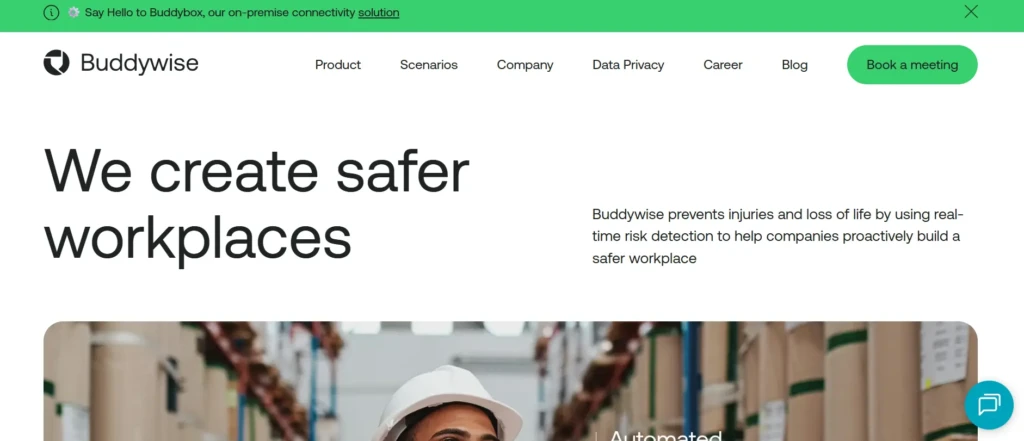
Buddywise provides peer-to-peer safety monitoring and collaborative hazard detection, emphasizing worker engagement and culture-driven safety improvement. The platform combines AI detection with human insight, creating hybrid safety systems where workers actively participate in hazard identification.
Key Strengths
Peer-Based Hazard Identification Buddywise enables workers to report and confirm hazards collaboratively. Rather than relying solely on automated detection, the platform encourages worker input, leveraging frontline expertise. Workers who participate in safety systems show higher engagement and ownership.
Gamification and Safety Culture Elements The platform includes recognition systems, safety challenges, and achievement tracking that make safety engagement positive rather than punitive. This cultural dimension drives sustained behavioral change beyond automated enforcement.
Real-Time Buddy Notifications Workers can alert peers to emerging hazards in real-time. This buddy-based approach recognizes that frontline workers often spot dangers first and can intervene before incidents occur.
Incident Context and Investigation Support When incidents occur, Buddywise captures context through worker observations alongside sensor data. This combination of automated detection and human perspective improves root cause analysis and prevention strategy effectiveness.
Mobile-First Worker Interface The platform prioritizes worker engagement through intuitive mobile apps. Safety personnel can report observations, acknowledge alerts, and participate in safety culture elements directly from work floors.
Safety Culture Metrics Buddywise tracks leading indicators of safety culture—near-miss reporting rates, peer interventions, safety communication frequency—alongside traditional lagging indicators like incident rates.
Best For
Buddywise works well for:
Organizations prioritizing safety culture development Companies with engaged workforces willing to participate in safety programs Operations seeking to move beyond pure monitoring to collaborative safety Mid to large organizations with diverse work locations Manufacturing and logistics operations where worker input drives innovation
Ideal for organizations recognizing that worker engagement drives better outcomes than surveillance-only approaches.
Why It Stands Out
Buddywise succeeds by acknowledging that workers are safety’s best resource. By combining AI detection with cultural elements and peer engagement, the platform achieves outcomes that pure automation cannot. Organizations report higher near-miss reporting, faster hazard identification, and improved safety culture.
Pricing Model
SaaS with engagement-based pricing typically ranging from $20,000-$60,000 annually depending on workforce size, facility count, and feature configuration.
Implementation Timeline
Program design and customization: 2-3 weeks Cultural deployment and staff training: 2-3 weeks Initial go-live and optimization: 1-2 weeks
Total timeline: 5-8 weeks for full implementation
Trade-offs
Success requires genuine commitment to worker engagement and culture change. Organizations seeking pure monitoring may find cultural features unnecessary. Requires active worker participation; passive implementations underperform. May require organizational culture assessment before implementation. Less suitable for highly automated or unmanned operations.
- Visionify.ai
What It Does
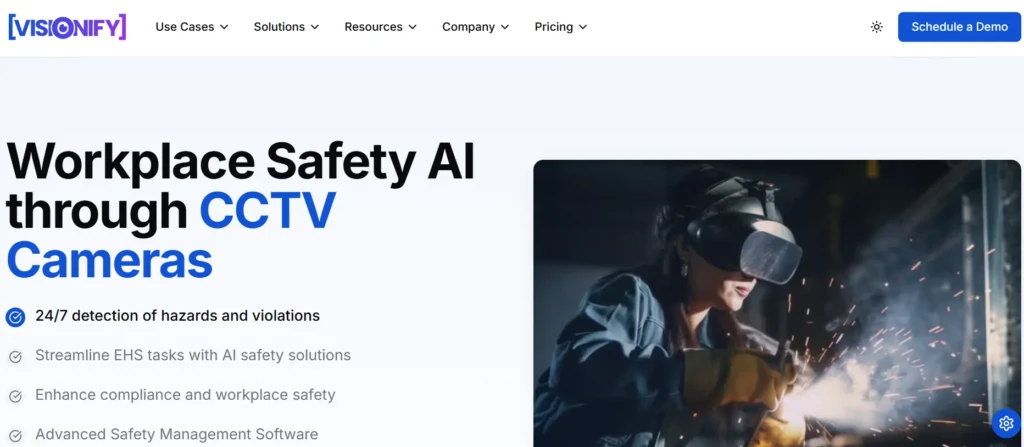
Visionify.ai specializes in real-time visual intelligence for workplace safety, combining edge computing with cloud analytics. The platform processes video data locally for immediate hazard detection while maintaining centralized reporting and trend analysis.
Key Strengths
Edge-Based Processing Visionify.ai processes video locally on edge devices rather than routing all data to cloud servers. This approach provides immediate hazard detection with minimal latency, critical for real-time intervention scenarios. Local processing also addresses privacy concerns by limiting data transmission.
Comprehensive Hazard Library Visionify.ai recognizes extensive hazard categories including PPE violations, unsafe behaviors, environmental hazards, equipment misuse, and situational hazards. The platform’s broad detection capability addresses diverse operational scenarios.
Flexible Deployment Options The platform supports cloud-native, on-premise, or hybrid deployments. Organizations with specific infrastructure requirements or privacy concerns can choose deployment models matching their needs.
Multi-Site Federation Visionify.ai enables distributed deployments across multiple locations with centralized oversight when desired. Local autonomy combines with enterprise visibility for large operations.
Advanced Privacy Controls Fine-grained privacy controls allow masking specific areas, anonymizing workers, or limiting data retention. Organizations can implement comprehensive monitoring while respecting privacy boundaries.
Integration Flexibility Visionify.ai integrates with diverse systems including existing VMS, ERP systems, and third-party safety platforms. This integration flexibility enables adoption alongside existing technology infrastructure.
Best For
Organizations with privacy-sensitive operations Manufacturing and logistics with diverse hazard profiles Multi-site operations requiring distributed deployment Organizations with specific data residency or regulatory requirements Companies wanting comprehensive hazard detection with flexible deployment Healthcare, food processing, and other sensitive environments
Why It Stands Out
Visionify.ai delivers comprehensive hazard detection while solving practical deployment challenges. Edge processing provides speed and privacy benefits that cloud-only solutions cannot match. Flexible deployment options accommodate diverse organizational requirements.
Pricing Model
SaaS with flexible deployment options typically ranging from $25,000-$70,000 annually. Options for perpetual licenses available for on-premise deployments.
Implementation Timeline
Infrastructure assessment and planning: 2-3 weeks System deployment and configuration: 2-3 weeks Integration and testing: 1-2 weeks Staff training and go-live: 1 week
Total timeline: 6-9 weeks for comprehensive deployment
Trade-offs
Edge processing requires investment in local computing resources. More complex than cloud-only alternatives. Steeper technical learning curve for configuration and maintenance. Integration complexity may exceed simpler point solutions. Better suited for organizations with technical capabilities than those seeking pure simplicity.
- Viact.ai
What It Does
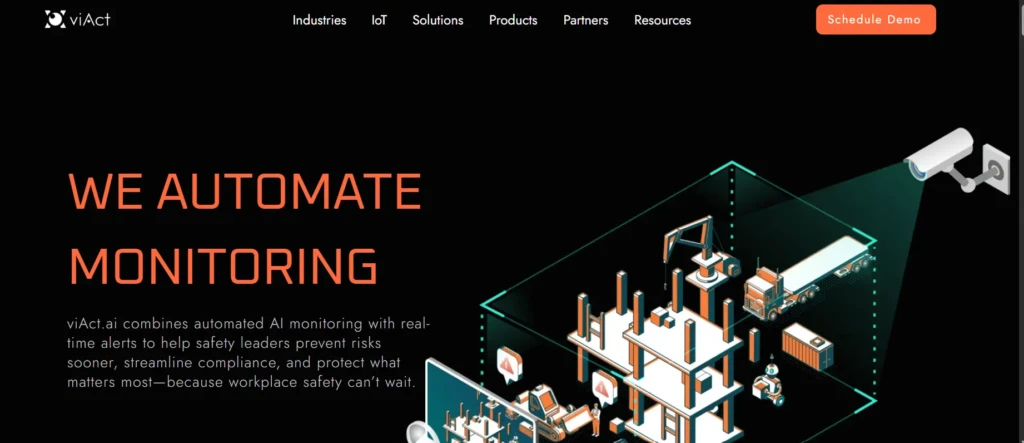
Viact.ai provides specialized AI safety monitoring engineered for complex operational environments with multiple equipment types, hazard interactions, and dynamic work processes. The platform excels at detecting compound hazards and contextual safety violations.
Key Strengths
Contextual Hazard Analysis Viact.ai recognizes that hazards interact and compound in context. The platform analyzes not just individual violations but how multiple factors combine to create risk. A worker wearing PPE who is also in a confined space without ventilation monitoring faces different risk than either violation alone.
Multi-Equipment Interaction Detection The platform detects unsafe interactions between workers and multiple equipment simultaneously. For facilities with complex machinery ecosystems, this compound detection prevents incidents traditional single-equipment systems miss.
Behavioral and Environmental Integration Viact.ai combines behavioral analysis with environmental monitoring. Unsafe behaviors become more concerning in high-temperature zones or around specific equipment. The platform captures these interactions.
Dynamic Risk Scoring Rather than binary hazard/no-hazard determination, Viact.ai provides continuous risk scoring reflecting real-time conditions. Safety teams understand not just that risk exists but risk magnitude enabling prioritized response.
Custom Alert Configuration Organizations can configure alert sensitivity reflecting actual operational requirements. Different areas, shift times, or work processes can have different alert thresholds.
Scalable Architecture Viact.ai’s architecture scales from single facility to enterprise deployments without performance degradation.
Best For
Viact.ai works well for:
Complex manufacturing with multiple equipment types Pharmaceutical and chemical processing Semiconductor and precision manufacturing Heavy industrial operations with compound hazards Organizations seeking sophisticated contextual analysis Facilities with dynamic work processes
Ideal for operations where hazard complexity demands advanced analytical capability.
Why It Stands Out
Viact.ai recognizes that real-world hazards are rarely simple. By analyzing compound factors and contextual interactions, the platform prevents incidents that simpler systems miss. Organizations deploying Viact.ai report improved incident prevention in complex scenarios.
Pricing Model
SaaS with enterprise pricing typically ranging from $40,000-$100,000+ annually depending on facility complexity, equipment diversity, and customization.
Implementation Timeline
Environmental analysis and configuration: 3-4 weeks System deployment and integration: 2-3 weeks Testing and refinement: 2 weeks Staff training and go-live: 1-2 weeks
Total timeline: 8-11 weeks for comprehensive implementation
Trade-offs
Higher cost reflecting analytical sophistication. Steeper learning curve for interpretation of contextual analysis. Requires detailed environmental mapping and configuration. Best suited for larger operations where complexity justifies investment. Less suitable for simple, straightforward operations.
- Survely.com
What It Does
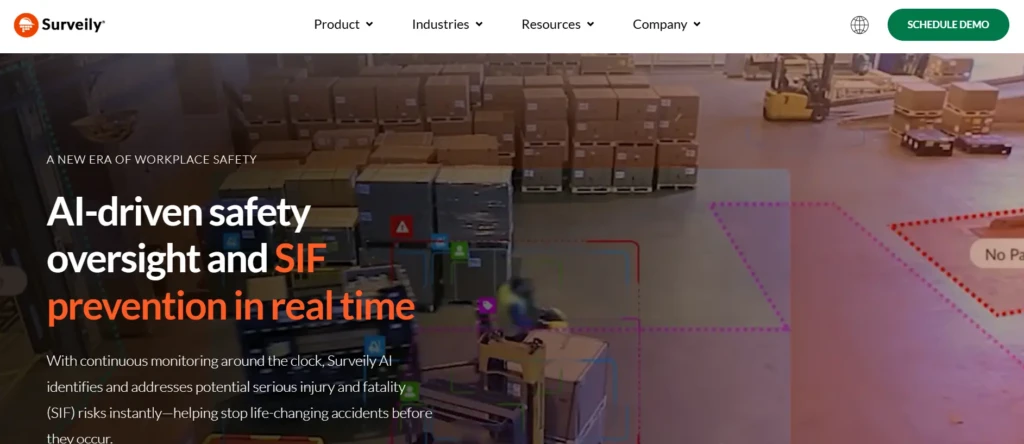
Survely.com provides integrated workplace safety and compliance assessment platform combining automated monitoring with systematic evaluation methodologies. The platform emphasizes comprehensive compliance documentation and audit readiness.
Key Strengths
Systematic Compliance Mapping Survely.com maps organizational operations to relevant safety regulations and standards. OSHA, ANSI, industry-specific requirements are systematically addressed. The platform documents compliance status and identifies gaps requiring attention.
Automated and Manual Assessment Integration The platform combines AI-powered automated detection with structured manual assessment processes. Safety professionals conduct documented observations while automated systems provide continuous monitoring. This hybrid approach captures both systematic and periodic evaluation.
Compliance Documentation and Audit Trails Every assessment, correction, and verification is documented with timestamps and responsible parties. This comprehensive record-keeping simplifies regulatory inspections and demonstrates good-faith compliance efforts.
Structured Inspection Workflows Survely.com provides pre-configured inspection templates reflecting industry requirements. Safety teams follow systematic processes ensuring consistent assessment and reducing compliance gaps.
Real-Time Compliance Scoring The platform provides current compliance scoring reflecting recent assessments and automated monitoring. Organizations understand compliance status and identify priority remediation areas.
Integration with Corrective Action Systems When compliance gaps are identified, Survely.com integrates with corrective action tracking ensuring identified issues receive attention and verification.
Best For
Survely.com works well for:
Regulated industries with complex compliance requirements Organizations facing regulatory scrutiny or upcoming inspections Companies wanting to demonstrate proactive compliance efforts Multi-site operations requiring standardized compliance assessment Healthcare, pharmaceutical, food processing, and similar regulated sectors Organizations prioritizing audit-readiness
Ideal for compliance-focused operations where documentation and systematic assessment drive value.
Why It Stands Out
Survely.com succeeds by making compliance visible and manageable. Organizations often struggle with compliance complexity—unclear requirements, incomplete assessments, inadequate documentation. Survely.com provides systematic approach converting compliance complexity into managed processes.
Pricing Model
SaaS with compliance-focused pricing typically ranging from $20,000-$60,000 annually depending on regulatory complexity, number of locations, and assessment frequency.
Implementation Timeline
Compliance requirement mapping: 2-3 weeks Process and workflow configuration: 2-3 weeks Staff training and initial assessment: 1-2 weeks Go-live and optimization: 1 week
Total timeline: 6-9 weeks for comprehensive implementation
Trade-offs
More compliance-focused than hazard detection-focused. Limited if comprehensive hazard monitoring is primary requirement. Configuration complexity reflects regulatory requirement complexity. Better suited for regulated industries than general operations. May need supplementary hazard detection systems for comprehensive safety approach.
Strategic Decision Framework
When selecting from multiple alternatives, systematic evaluation prevents costly missteps.
1. Deployment Timeline Assessment
Ask yourself: How urgent is the need? Organizations facing immediate safety challenges prioritize rapid-deployment platforms. Those able to invest time can leverage more sophisticated systems.
2. Operational Complexity Analysis
Simple, straightforward operations have different requirements than complex multi-equipment environments. Voxel.ai and Viact.ai address complexity; simpler platforms serve straightforward scenarios.
3. Privacy and Cultural Requirements
How important are privacy and worker engagement? Organizations with strong privacy commitments or culture-focused initiatives choose accordingly. Visionify.ai and Buddywise address these dimensions explicitly.
4. Regulatory and Compliance Needs
Heavy compliance requirements favor Survely.com’s systematic approach. Operations with simpler compliance needs choose based on other criteria.
5. Organizational Scale Alignment
Small operations (under 50 employees, single location): Rapid-deployment platforms provide best value.
Mid-market (50-500 employees, 2-5 locations): Most platforms fit well; match specific needs to platform strengths.
Large operations (500-5,000+ employees, multiple locations): Sophisticated platforms justify investment; choose based on operational complexity, compliance needs, and strategic priorities.