 Observia Editorial Team
You’ve narrowed your AI workplace safety search to three platforms. All three detect PPE violations. All three promise real-time alerts. All three integrate with existing cameras. All three claim to reduce incidents.
So why do they feel different when you demo them?
Because they’re solving different problems for different types of facilities.
This isn’t a “best platform wins” comparison.
It’s a “which platform fits your operation” guide. Understanding the differences means choosing confidently instead of guessing.
Head-to-Head: The Core Positioning
Visionify AI
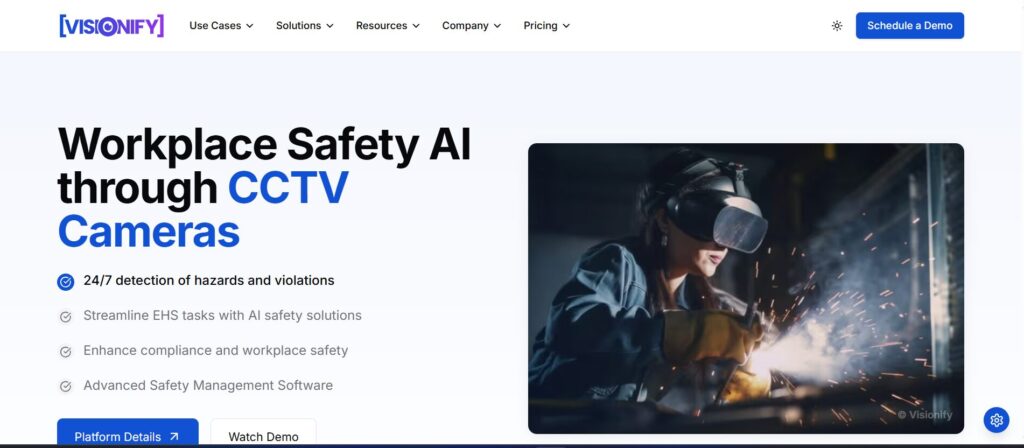
Primary positioning: Enterprise-grade workplace safety platform trusted by Fortune 500 manufacturers and mid-market operations. Focus on rapid deployment, ease of use, and comprehensive hazard detection.
What they emphasize: Privacy-first design. Multi-camera deployment at scale. No system modifications needed. Works with your existing infrastructure.
Target customer: Facilities with multiple locations, diverse camera setups, and need for quick implementation without IT overhead.
viAct
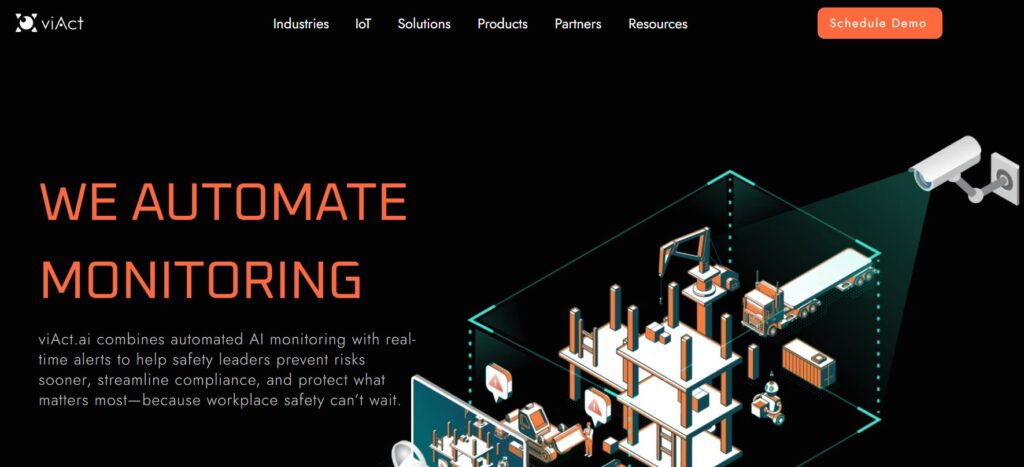
Primary positioning: Industry-specific safety system for construction, oil/gas, mining, and heavy manufacturing. Operating since 2016 with hundreds of proprietary algorithms deployed in harsh environments.
What they emphasize: Scene-specific detection (scenarios unique to their target industries). Jobsite-ready hardware and software. Customizable hazard definitions. Real-time data transfer to centralized platform.
Target customer: Heavy industry operators managing dynamic worksites, large contractor networks, and complex multi-site hazard profiles specific to construction/energy sectors.
Observia AI
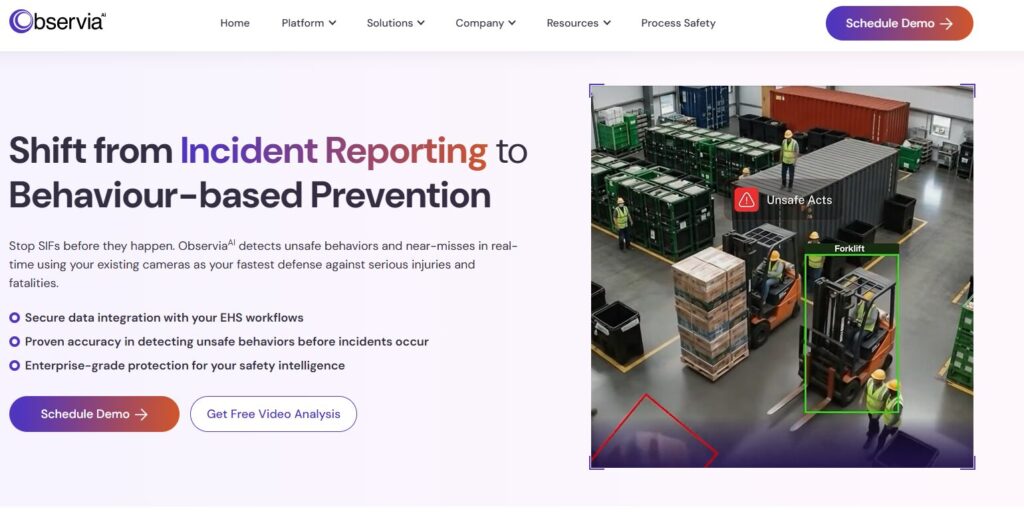
Primary positioning: Safety-as-a-Service platform designed for continuous compliance automation. Emphasis on behavioral pattern recognition and proactive incident prevention rather than reactive detection.
What they emphasize: Pattern interruption on day one. Compliance automation before problems escalate. Integration with existing safety workflows. Focus on root cause understanding, not just violation flagging.
Target customer: Facilities serious about moving from periodic audits to continuous safety management. Organizations where compliance consistency matters more than detection breadth.
Feature Comparison: What Each Platform Delivers
PPE Detection Capability
Visionify: Detects missing helmets, vests, goggles, gloves, safety harnesses. Works well in standard manufacturing and warehouse environments. Detection is reliable across standard scenarios.
viAct: Detects PPE gaps with industry-specific customization. Detection algorithms are tuned for construction lighting conditions, outdoor environments, and complex equipment scenarios. Superior performance in non-standard industrial environments (jobsites, outdoor operations, mining).
Observia: Detects PPE violations (helmets, vests, gloves) with emphasis on pattern frequency and behavioral habits. Detection is solid, but the platform’s strength isn’t in the breadth of detection categories, it’s in understanding which violations matter most based on facility-specific risk profile.
Winner for pure PPE detection: viAct (industry-optimized algorithms). Visionify close second (reliable across standard scenarios). Observia adequate but differentiated by analysis, not detection breadth.
Beyond PPE: Broader Hazard Detection
Visionify: Detects PPE gaps, slip/trip/fall incidents, unauthorized zone entry, unsafe equipment handling, ergonomic violations. Broad hazard coverage without specialization.
viAct: Detects hazards specific to construction/energy: fall from height, struck-by incidents, caught-between hazards, fire safety violations, equipment collision risks, alongside PPE gaps. Scenario-based detection reflects industry-specific risks.
Observia: Focuses primarily on PPE and unsafe behaviors with real-time alerts. Not positioning as a comprehensive hazard detection platform. Strength is in what happens with the data after detection, not in the breadth of detectable hazards.
Winner for hazard breadth: viAct (industry-specific). Visionify (general-purpose breadth). Observia (focused not broad).
Real-Time Alert System
Visionify: Push notifications to mobile devices and dashboards. Configurable alert rules. Can set different alert levels based on hazard severity. Integrates with smart devices for escalated alerts.
viAct: Real-time alerts pushed to mobile and viHUB centralized platform. Supports escalation workflows for urgent hazards. Jobsite-specific routing (alert goes to site supervisor, then escalates to safety manager if not acknowledged).
Observia: Real-time alerts with emphasis on pattern context. Alert includes not just “violation detected” but “this is the 3rd violation this week at this location” or “this worker has 2 prior violations this month.” Contextual alerting helps supervisors understand whether this is an isolated incident or part of a pattern.
Winner for alert sophistication: Observia (context-aware). viAct (workflow-optimized). Visionify (straightforward and reliable).
Pattern Recognition and Analytics
Visionify: Standard analytics dashboard showing incident frequency, location heatmaps, violation types. Trend reporting over time. Basic pattern identification.
viAct: Advanced analytics through viHUB platform. Tracks incidents by jobsite, crew, supervisor, equipment type. Trend analysis with predictive capabilities. Supports complex multi-site comparisons.
Observia: Pattern recognition is core to the platform. Automatically flags when violations form patterns. Identifies root causes by analyzing frequency, location clustering, time-of-day concentration, and individual behavior. Pattern interruption is the stated goal, catching behaviors before they become habits.
Alert Sophistication Winners
Industry-leading solutions recognized for excellence
Observia
Context-Aware
Advanced context awareness that understands the full scope of your alerts, delivering intelligent and relevant notifications.
viAct
Workflow-Optimized
Seamlessly integrated with your existing workflows, designed to optimize operations and enhance productivity.
Visionify
Straightforward & Reliable
Simple, dependable, and transparent. Delivers consistent performance you can trust, every single time.
Integration Capability
Visionify: Works with 95%+ of existing cameras. No hardware replacement needed. API available for custom integrations. Limited pre-built integrations with major EHS platforms.
viAct: Camera-agnostic with hardware option for remote jobsites. Strong integration with project management and field tools (equipment tracking, crew management). Proprietary viHUB platform centralizes data across multiple jobsites.
Observia: Designed to integrate with existing EHS workflows and safety management systems. Emphasis on working within your current processes rather than forcing new ones. Integration with incident reporting, training, and compliance platforms.
Winner for integration philosophy: Observia (workflow-integration focused). Visionify (hardware-agnostic). viAct (jobsite-tool integrated).
Deployment and Setup
Visionify: Rapid deployment. Works with existing camera infrastructure. Minimal IT involvement. Demo to production typically 2-4 weeks. Setup is straightforward.
viAct: More complex deployment, particularly for multi-site operations. Jobsite-specific customization requires up-front work. Professional services typically involved. 4-8 week typical implementation timeline.
Observia: Moderate deployment timeline. Requires facility-specific risk profile definition (what constitutes “unsafe” for your operation). Pattern baseline needs to be established. 6-10 week typical implementation.
Winner for speed: Visionify (fastest to production). Observia (moderate, but thorough). viAct (slower, but more comprehensive setup).
Privacy and Data Handling
Visionify: Privacy-first by design. Processes video locally on-device when possible. Minimal personal data retention. GDPR compliant. Clear data governance policies.
viAct: Data handling varies by configuration. Can be on-premises or cloud. Designed for jobsite data collection, so cloud transfer is standard. GDPR-compatible but data residency options may be limited.
Observia: Balanced approach. Can operate on-premises or hybrid. Emphasis on data security as part of Safety-as-a-Service model. Privacy is addressed but not positioned as primary differentiator.
Winner for privacy-first: Visionify (strongest privacy positioning). Observia (balanced). viAct (jobsite-focused, data transfer standard).
Implementation Complexity: What You’re Actually Signing Up For
Initial Setup
Visionify: Simple. Connect cameras. Define alert thresholds. Start monitoring. Your IT team can handle it with vendor support.
viAct: Moderate to complex. Jobsite-specific scenario definition. Integration with your field management systems. Professional implementation services recommended.
Observia: Moderate. Define your facility’s risk profile. Establish baseline patterns. Train safety team on pattern interpretation. Requires more upfront safety input than technical input.
Ongoing Customization
Visionify: Minimal. Adjust alert thresholds as needed. Add cameras as you scale.
viAct: Continuous. Different jobsites may need scenario adjustments. New equipment types require algorithm tuning. Ongoing professional services may be needed.
Observia: Moderate. Refine what gets flagged based on actual patterns. Adjust intervention protocols as you learn what works.
Team Adoption
Visionify: High adoption ease. Interface is intuitive. Minimal training required. Teams adopt quickly.
viAct: Moderate adoption. Jobsite supervisors need training on scenario-specific alerts. Safety managers need training on viHUB analytics.
Observia: Requires behavioral mindset shift. Teams need to understand pattern-based safety thinking. Training focuses on “why patterns matter” not just “how to use the system.”
Real-World Scenarios: Which Platform Wins Where
Scenario 1: Multi-Location Manufacturing Facility (3 sites, 500+ employees)
Visionify wins. You need rapid deployment across multiple locations. Existing camera infrastructure is already in place. You want a system that just works without extensive configuration. Visionify’s “plug and monitor” approach solves your problem fast.
Observia competitive. If you’re struggling with PPE compliance patterns that repeat across locations, Observia’s cross-site pattern analysis helps you understand whether it’s a training issue (needs consistent intervention) or a systemic issue (needs policy change).
viAct not ideal. Manufacturing facilities don’t need construction-specific detection. viAct’s complexity is overhead you don’t need.
Scenario 2: Large Construction Contractor (15+ active jobsites)
viAct wins clearly. Construction-specific detection is built in. Fall detection, struck-by, equipment collision all scenarios viAct algorithms handle well. Multi-site coordination through viHUB solves your distributed management problem. Scenario-based customization means different jobsite types are handled appropriately.
Visionify reasonable alternative. Works fine for general PPE and unsafe behavior detection. No construction-specific advantages, but simpler to deploy across changing jobsites.
Observia not ideal. Pattern recognition works, but dynamic jobsite environment (constantly changing crews, equipment, hazards) doesn’t leverage Observia’s behavioral pattern strength. Patterns shift too quickly.
Scenario 3: Warehouse Operation (single large facility, 200+ employees, PPE compliance is main focus)
Observia wins. PPE patterns in warehouses are consistent and repetitive. Same workers, same zones, same shift patterns. Observia’s strength is identifying that Worker A skips gloves during slow periods, or that forklift operators rarely wear vests during quick runs. Root cause understanding leads to targeted solutions.
Visionify also works well. Simpler to implement. Adequate detection. No pattern analysis overhead if you don’t need it.
viAct overkill. Construction-focused features add cost without value in a warehouse context.
Scenario 4: Oil/Gas or Mining Operation (harsh environment, multiple hazard types, remote locations)
viAct wins. Industry-specific algorithms for hazardous energy, confined spaces, struck-by risks. Remote site support is designed into their model. Harsh environment performance (lighting, weather, visibility challenges) is where viAct’s proprietary algorithms show value.
Visionify works but with limitations. General algorithms may not handle lighting and environmental conditions as well. Adequate for basic PPE detection but not for industry-specific complex hazards.
Observia possible but not optimal. Pattern recognition works, but only after deployment. Industry-specific detection gaps might exist during setup phase.
Pricing Reality: What You’ll Actually Spend
Visionify
Typical range: $15,000-40,000 annually depending on number of cameras and locations.
What’s included: Platform access, detection algorithms, standard analytics, support.
Additional costs: Integrations with other systems may require professional services ($2,000-5,000).
ROI timeline: 6-12 months (quick implementation means faster payback).
viAct
Typical range: $30,000-75,000+ annually depending on number of jobsites and customization complexity.
What’s included: viHUB platform, industry-specific detection, professional implementation, jobsite-level customization.
Additional costs: Remote site equipment (if not using existing cameras), advanced analytics modules, ongoing scenario customization.
ROI timeline: 12-18 months (longer implementation, higher value for complex environments).
Observia AI
Typical range: $20,000-50,000 annually depending on facility size and complexity.
What’s included: Real-time detection, pattern analysis, behavioral insights, integration support, Safety-as-a-Service framework.
Additional costs: Custom workflow development, training on pattern-based safety approach, incident reporting integration.
ROI timeline: 6-12 months (depends on whether organization embraces pattern-driven safety methodology).
The Decision Framework: Questions That Actually Matter
Question 1: What’s Your Industry?
If construction/energy → viAct likely wins on industry-specific detection. If manufacturing/general industry → Visionify or Observia. If focused on PPE patterns → Observia.
Question 2: How Many Sites?
Single site → Simplicity matters, Visionify or Observia. Multiple sites (2-5) → Integration matters, Observia or Visionify. Many sites (10+) → Scale and management matter, viAct or Visionify.
Question 3: What’s Your Main Challenge?
“Workers keep violating PPE in patterns” → Observia directly addresses this. “We need fast deployment and broad hazard detection” → Visionify. “Complex hazards specific to our industry” → viAct. “We’re struggling with compliance consistency” → Observia.
Question 4: How Much IT Complexity Can You Handle?
“Just plug it in” → Visionify.
“We can handle some customization” → Observia.
“We want deep integration with our systems” → viAct.
Question 5: Is Continuous Safety Culture Built-In or Do We Need to Build It?
If your team already thinks about safety patterns and prevention → Observia will resonate.
If your team thinks in terms of incident response and compliance → Visionify.
If your team thinks in terms of industry-specific hazards → viAct.
The Honest Assessment
Visionify
Strengths: Privacy-first design, rapid deployment, works with existing infrastructure, broad hazard detection, high adoption ease.
Weaknesses: Pattern recognition is basic, not positioned for deep root-cause analysis, may feel over-engineered for simple operations.
Best for: Organizations wanting a reliable, straightforward system that works quickly and doesn’t require extensive customization.
viAct
Strengths: Industry-specific detection algorithms, purpose-built for complex environments, excellent multi-site coordination, scenario-based customization.
Weaknesses: Longer implementation timeline, more complex to deploy, higher cost, not ideal for general manufacturing/warehouse operations without heavy industry-specific hazards.
Best for: Construction, oil/gas, mining, and other organizations where industry-specific hazards are the real safety challenge.
Observia AI
Strengths: Behavioral pattern focus, root-cause oriented, Safety-as-a-Service positioning, integration with existing workflows, helps teams move from reactive to proactive.
Weaknesses: Requires organizational mindset shift toward pattern-based thinking, implementation isn’t the fastest, requires more upfront safety input than technical input.
Best for: Organizations serious about preventing incidents by understanding behavioral patterns, not just catching violations. Facilities where consistency matters more than breadth.
The Real Question: Implementation Success
All three platforms can detect unsafe acts. The question that actually determines success is simpler: Will your team actually use the data this system generates to change behavior?
Visionify: They’ll use it if the interface is intuitive and alerts don’t overwhelm them (they probably will).
viAct: They’ll use it if your jobsite supervisors are trained on what the alerts mean for construction-specific hazards (they probably will with training).
Observia: They’ll use it if your safety team understands that patterns matter more than individual incidents (this requires mindset shift).
The best system isn’t the one with the most features. It’s the one your actual team will trust, understand, and act on consistently.
The Final Recommendation Framework
Choose Visionify if: You want rapid deployment, broad hazard detection, enterprise-grade reliability, and minimal IT overhead. You’re comfortable with standard alert-and-respond workflows.
Choose viAct if: You’re in construction, energy, mining, or other industries with specific hazard profiles. You manage multiple jobsites or remote operations. Industry-specific detection accuracy is non-negotiable.
Choose Observia if: You’re struggling with PPE compliance patterns that repeat. You want to understand root causes, not just catch violations. You’re serious about moving from periodic audits to continuous safety management. Your team is ready to think about safety as pattern interruption, not incident response.
The Next Step
Don’t choose based on feature lists. Demo all three in your actual facility, with your actual cameras, showing your actual safety challenges.
Ask each vendor: “Show me how your system would handle our biggest current safety challenge.”
Watch which answer sounds like they understand your actual problem versus which sounds like a generic solution.
That’s where the real difference emerges.