Executive Summary
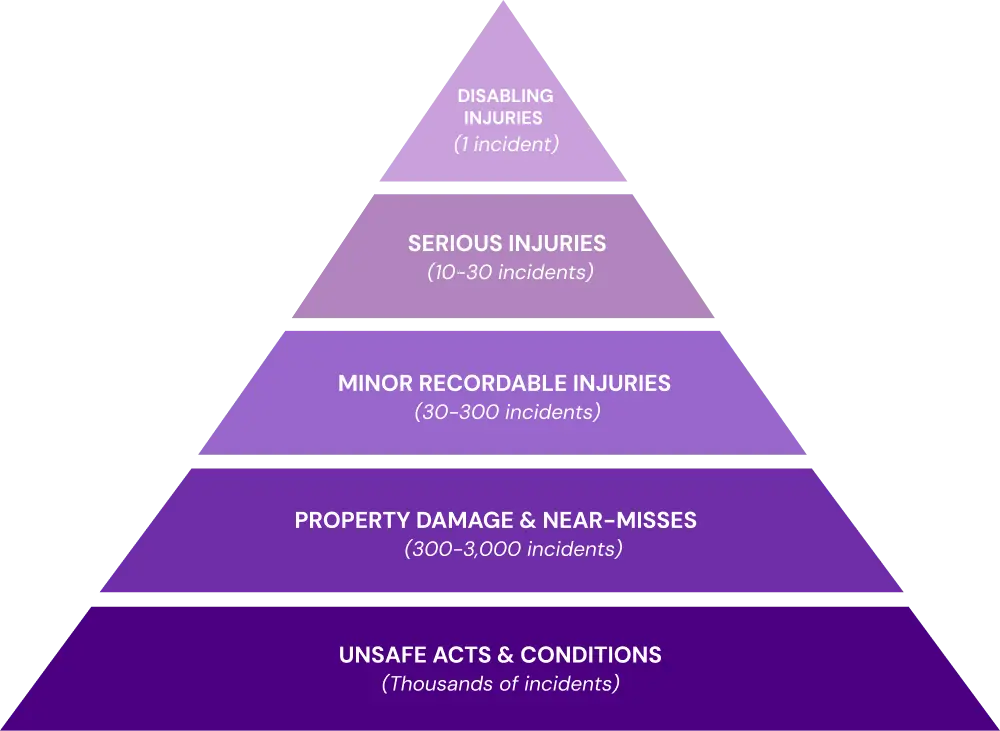
For nearly a century, workplace safety professionals have operated with a fundamental misunderstanding about how accidents occur. Most organizations invest heavily in responding to serious injuries and fatalities, the visible tip of the iceberg. Yet the real determinant of safety performance lies beneath the surface: in the thousands of unsafe behaviors, near-misses, and system failures that precede every serious incident.
who should read this:
- Financial Leaders committed to building robust safety programs through strategic investment in their teams
- EHS Managers dedicated to fostering safety leadership grounded in the Hendrick Triangle framework
- Safety Specialists interested in understanding the risk-based rationale behind their standard operating procedures
Key Findings
- Organizations that systematically respond to near-miss reports reduce serious injuries by 45-78%
- A facility managing 800+ workers reduced recordable injuries by 78% through near-miss engagement
- For every serious injury, there are hundreds of identifiable warning signs that go unaddressed in most organizations
- Leading indicator tracking (near-misses, unsafe acts) predicts safety performance far more accurately than lagging indicators (injury rates)
The Problem: Why Traditional Safety Approaches Fail
Sarah was frustrated. As a production supervisor at a manufacturing plant, she watched her team dutifully complete paperwork for “meaningless” near-misses, workers almost slipping, tools nearly falling, close calls with forklifts. “We’re wasting time documenting things that didn’t even happen,” she told her safety manager.
Six months later, a serious accident occurred in her facility. The investigators traced it directly to the exact same hazard patterns her team had been reporting as “meaningless.”
This story repeats itself across industries because most organizations have fundamentally inverted their safety priorities. They focus resources on the dramatic incidents, the fatalities and major injuries that trigger investigations, lawsuits, and regulatory scrutiny. Meanwhile, the foundation upon which these serious incidents are built remains largely invisible and unaddressed.
The results are predictable: safety improvements plateau, near-miss reporting atrophies (workers learn that reporting doesn’t matter), and organizations become vulnerable to preventable serious incidents.
The conventional approach treats safety as a compliance requirement rather than a system challenge. But safety isn’t a state, it’s a process. And that process determines whether your organization experiences serious injuries or prevents them.
Understanding the Safety Pyramid: A Historical and Modern Context
The Framework:
The Safety Pyramid is a visual representation of how safety incidents cluster and relate to one another within organizations. Like an iceberg, what we see represents only a fraction of the total picture.